Skip to main content Skip to search Skip to main navigation

Questions + Answers (FAQ)


Here you will find answers to frequently asked questions.
Should your question not be listed here, simply send us an e-mail or give us a call.

Costs, benefits & comparison with other model types

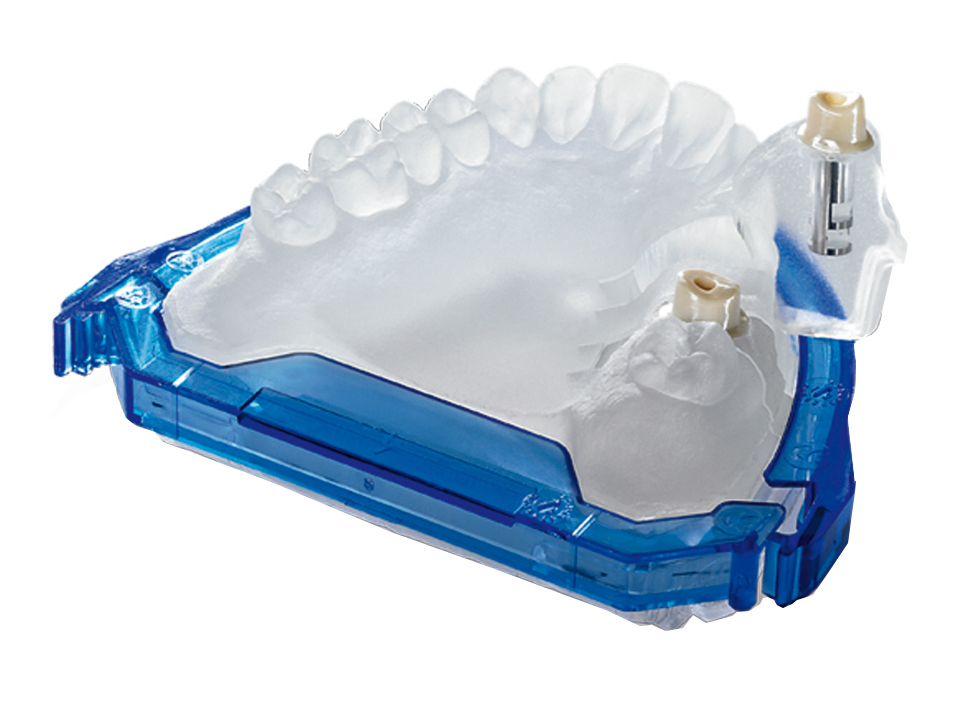
In only 4 steps to the perfect model. Align - Pour out - Demould - Segment! As the dental arch and base in particular are fabricated in a single operation, this results in a saving of working time of up to 75%, depending on the number of dies. Drilling in base plates or dental arches, necessary relief cuts to compensate for dimensional distortions or bonding of pins and bases of dental arches are completely eliminated with the model-tray® system. Fewer work steps also translate into fewer sources of error and thus lower time and cost expenditure.

The model-tray® base former allows 5-fold re-use at highest precision, so that the tray costs are only approx. € 1.- per model. In fact, due to the significantly lower work effort, material costs are virtually eliminated. Even the purchase of a model-cut model sawing machine is amortised within a few months.

The three-dimensional, even expansion of the plaster ➤ in the model-tray® by about 0.08% compensates for the contraction of the impressive mass after removal from the warm oral cavity. Thus, this die model which is produced as a full model, represents the best possible, most dimensionally accurate oral situation. The associated preservation of the palate area ensures a desired model analysis. The saw die model and the opposing bite fit together precisely as they are fabricated as full models.

The relief cuts required for a pin-guided, plastic-based dental arch model are intended to compensate for the distortion which occurs due to expansion. It is only through these cuts, placed at regular intervals which are not too far apart, that the segments can be repositioned perfectly on the plastic base. Thereby the expansion of the plaster should fall into the saw cut. The result can lead to weak or even missing contact points.

Handling and function

Align - Pour out - Demould - Segment!
The individual processing steps are presented simply and comprehensibly in the application poster ➤ and in the >video "Four steps to a perfect model" ➤ 

Plaster expansion is largely complete after 1.5 hours. The plaster has reached its necessary edge stability. Only then is the model-tray® model demoulded. The high-quality polycarbonate of the model tray adapts precisely to the expanding plaster model due to thermal expansion, and allows being reused five times with maximum precision. Full completion of the plaster expansion also ensures accuracy of fit when repositioning the basic model and the die segments in the tray.

The three-dimensional, uniform expansion of the plaster and the model-tray® by approx. 0.08%, compensates for the contraction of the impression material after removal from the warm oral cavity. Relief cuts to compensate for dimensional distortions, e.g. in the case of dental arch models with a plastic-based pin, are not necessary with the model-tray® model.

model-tray® models can be used in all common articulators on the market, which is often not mentioned by competitors.

model-tray® adapters ➤ are available for "plaster-free insertion", making articulation even more comfortable.

In principle, all common dental plasters of Class 4 with thermal setting expansion are suitable for the model fabrication with model-tray®. The respective manufacturer's instructions for storage and processing should be observed.

Expansion

The model-tray® model expands three-dimensionally and uniformly by only approx. 0.08% due to its full model shape and in the process compensates for the contraction of the impression material after removal from the warm oral cavity. There are no dimensional distortions as with horseshoe-shaped dental arch models. Due to thermal expansion ➤ the model-tray® adapts exactly to the expanding plaster model. (Gypsum expansion does not move upwards as is often assumed.) As a separate gypsum base is not fabricated, the undesired secondary expansion is also eliminated.

Application options

Implant work can be fabricated particularly well on the pinless model-tray® model with the stable die segments and integrated base. There are no limitations whatsoever due to distracting pins as with other pin-guided model types.

model-tray® offers corresponding adapters for all common scanners ➤ with which the model-tray® model can be positioned and fixed optimally in the scanning range. In addition it can also be conveniently removed between the individual scanning processes and then returned to the correct position.

To perform a necessary single die scan, the die segment can be transferred into a similar matt SCAN-TRAY ➤ and also performed without reflections.

When fabricating a model-tray® die model, the palatal area or the lingual area are retained. A second impression is not necessary.

With the duplicator from model-tray® ➤ - a closed duplicating system - model-tray® models can be duplicated easily and accurately! In fully encapsulated duplication, the expansion pressure is converted into compression pressure when the refractory investment material sets. This is where the physical law "Pressure creates counterpressure" comes into play. Refractory investment materials are porous in principle. This is one reason why the materials can be condensed when setting under pressure. Due to the resulting compression pressure, the duplicate models have a much harder and smoother surface than usual and can be exchanged for the original model in the articulator with an absolutely perfect fit.

Retentions, supports or occlusal surfaces can therefore be modelled optimally in the articulator.

In the case of commercially available non-closed duplicating moulds, where the duplicating material can escape the expansion pressure of the investment material, several setting centres at various independent locations are created during the crystallisation process (setting process). The expansion values between the thick and thin model sections exhibit different values. The form of the duplicate model is therefore not identical to that of the master model. Working in the articulator is not possible!

Working, situation, diagnostic and master models, as well as model casting and combination prosthetics, can also be fabricated quickly and easily with model-split ➤  The model-split base is equipped with a 45° split cast and allows good examination of the bite situation.

With the Intercuspidator ➤ the models can be fabricated precisely and quickly after closed mouth partial impression and can also be articulated without plaster in the same work step. Upper and lower jaw models are located in the intercuspidator with maximum intercuspidation. In addition, the intercuspidator enables protrusion and laterotrusion movements resulting from the sliding surfaces of the existing dentition.

With the Intercuspidator, single-tooth and 2- to 3-unit restorations, which account for over 50% of all cases, can be fabricated quickly and precisely.

With the alignment base as an additional module, individual models with separate bite registration can also be processed in the Intercuspidator ➤ as well as being used plaster-free.

With the intercuspidator, single-tooth and 2- to 3-unit restorations, which account for over 50% of all cases, can be fabricated quickly and precisely.

Sawing model-tray® models

model-tray® models can be segmented both manually and automatically without limitations by pins.

The model should always be sawn to the predetermined breaking point. The breaking edge is used for later fit control. The individual processing steps are presented simply and comprehensibly in the application poster ➤ and in the video "Four steps to a perfect model" ➤  Automatic sawing with the model-cut model sawing machine ➤ offers the technician the greatest possible occupational safety at rational and clean operation.

As the model-cut saws from vestibular to palatinal/lingual, there is no breaking of the plaster edges at the preparation margin. The cutting width of the saw cuts is only 0.20 to 0.36 mm. Inclined cuts of up to 15° can also be easily made in case of diverging dies by tilting the model holder.

The three-dimensional, uniform expansion of the plaster and the model-tray® by approx. 0.08%, compensates for the contraction of the impression material after removal from the warm oral cavity. Relief cuts to compensate for dimensional distortions, e.g. in the case of dental arch models with a plastic-based pin, are not necessary with the model-tray® model.

Tips: What to do if ...?

The model has already been demoulded before plaster expansion was fully completed (after approx. 1.5 hours). In this case, the model continues to expand outside the tray until expansion is complete and then no longer fits exactly into the tray -> see application poster ➤ or video "Four steps to a perfect model" ➤

Or the tray has been re-used too often (recommendation: cast up to 5 times at the most). In most cases it is then also difficult to close the rim and lock (see also next point).

The cleanliness of the tray should be checked, if necessary clean the tray briefly with a compressed air gun. The model-tray® system alerts to possible processing errors.

Possibly the tray was removed too early or the tray was used for casting too often.

Possibly the model has already demoulded before plaster expansion was fully completed (after approx. 1.5 hours). The basic model could not be precisely repositioned in the tray (there may also be contamination in the tray), whereby the die segments demonstrate their correct fit via the saw cuts. -> see application poster ➤ or video "Four steps to a perfect model" ➤

Possibly the model has already demoulded before plaster expansion was fully completed (after approx. 1.5 hours). The basic model could not be precisely repositioned in the tray (there may also be contamination in the tray), whereby the die segments demonstrate their correct fit via the saw cuts. -> see application poster ➤ or video "Four steps to a perfect model" ➤

The model may possibly have become jammed when lifting with compressed air. -> The model can be returned to the correct fit by lightly tapping on the tabletop. When lifting the model again with compressed air, lightly press it against the palatal surface with your thumb or the lock so that the model cannot tilt. Subsequent light blows with a horn hammer ➤ to the edge of the tray facilitate demoulding.

The optimum speed of the tungsten carbide saw blade is 1,500 rpm. The best time to saw the model is after 90 to 120 minutes of starting to mix the plaster. Some types of plaster develop such high values after only 12 hours that sawing one hardened model is already sufficient to cause premature wear of the saw blade.

However, the models can also be easily sawed the next day if the model is stored in a hydrobox (airtight plastic container with a moist insert) after the impression has been lifted off (after 30 minutes). The model therefore does not dry out and the carbide saw blade does not become blunt prematurely!

Blunt carbide saw blades should be replaced in good time, otherwise there is an increased risk of breakage. -> Blunt tungsten carbide saw blades can be re-sharpened by us at low cost.

The saw blade may possibly have become jammed when mounting and breaks when the retaining screw is tightened. -> Before clamping a new saw blade, the saw blade holder should be checked for any burrs and be carefully cleaned, otherwise this could lead to breaks later on.

First check the fit and running direction of the clamped saw blade. The model must be firmly secured to the model table and must not wobble. Check the quick release catch of the model table for firm tension. The model table must not demonstrate any play. Otherwise an overhaul of the model table in our workshop might be possibly be advisable to restore full functionality and to minimise the risk of breaking saw blades.

If a carbide saw blade is already blunt, there is an increased risk of breakage. -> Blunt tungsten carbide saw blades can be re-sharpened by us at low cost.

No results.