

The first dental applications can be found in 1770 when the court dentist of Friedrich the Great used plaster as a model material in the manufacture of dentures. In 1840, plaster was first used as an impression material. (source: www.dzw.de/modellherstellung-die-10-gipsgebote)
By filling the impression taken in the mouth (negative form) with a model material, a positive form of the oral situation, the situation model, is obtained after hardening of the model material. Hardly any other material has shaped the history of dental technology as much as dental plaster.
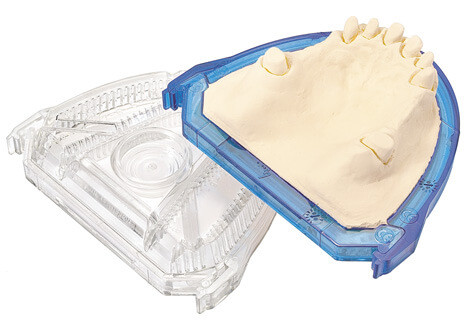
Since then, a lot has happened in dental technology and nowadays the model-tray model system in offers a precise production of saw-cut models without pins - in just 4 steps. It meets the highest demands for today's modern dental laboratory.
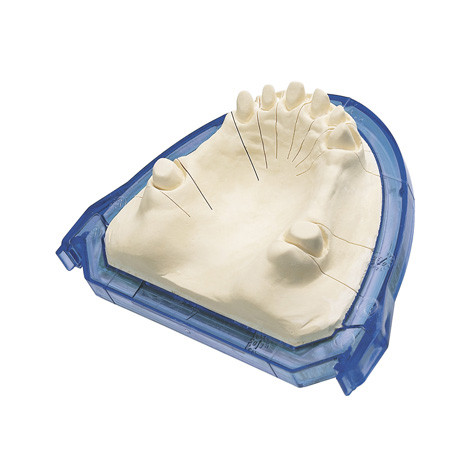
The model-tray model, with its integrated base and pinless segments, is particularly well-suited to the fabrication of sophisticated implant models without interference from implants already positioned. Since there is no fabrication of base or adhesion of pins necessary, model-tray not only saves time, but also eliminates possible sources of error through fewer work steps.
Model Fabrication in 4 steps
First step Align: Align the impression with the markings on the model-positioner. An optimal position of the impression guarantees an aesthetic model and good handling.
Second step Pour out: Pour out the tray and impression and close the model-positioner. The complete saw cut model is manufactured in just one operation.
Third step Demould: After 90 minutes, the finished model can be removed from the model-tray. No additional work steps are necessary like in other model fabricating methods.
Fourth step Segment: Saw the model manually or by machine without restrictions by pins. The model-tray plaster model enables very fine segmentation and entirely free cutting positions.

Highest quality
- The high-quality polycarbonate of the model-tray enables 5 x use with the highest accuracy.
- Through thermal expansion, the model-tray precisely adjusts to the expanding plaster model.
- Stable die segments without being restricted by annoying pins.
- Implant work can be easily done on the pinless model with integrated base.

Easy and cost-saving work steps
- No annoying insertion, drilling or adhesion of pins.
- Dental arch and base are manufactured in one work step.
- Up to 75 % in time saving.

The clever system in daily laboratory.Start now with only € 95.00 and save 50%.


The comfortable entry with magnet.€ 165.00 which are worth it.

In combination with the Intercuspidator particularly suitable for closed-mouth partial impressions.
Content: 20 pc./pcs. (€3.50 / 1 pc./pcs.)

Model fabrication and simultaneous plaster-free mounting in the articulator in maximal intercuspidation. - This article is currently not available -